
Once a hotel is in good shape, charge 10 to 20% above the market rate. Cutting your price can lift occupancy by a quarter at most, while every room you sell earns less, so cheap rooms rarely make up the difference. The things that really fill a hotel are reputation, condition and the right staff.
The market rate
Every hotel has a market rate, set by its room tier and its part of the city. In London:
| Hotel | Market rate per night |
|---|---|
| Outer London, Budget | about £50 |
| Outer London, Standard | about £81 |
| Inner London, Standard | about £97 |
| Inner London, Superior | about £150 |
| Central London, Boutique | about £260 |
| Prime London, Luxury | about £641 |
The rate slider on the Pricing tab lets you set anything within your room tier's band. Each hotel shows its projected occupancy and revenue before you commit.
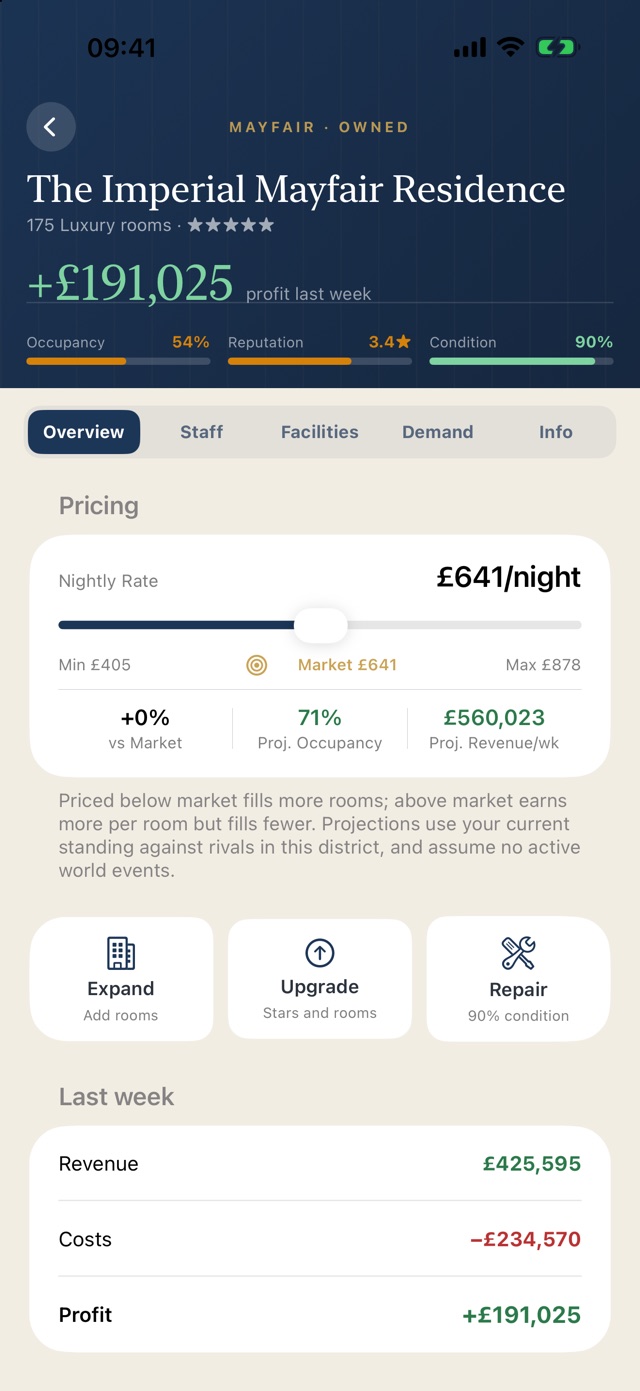
How occupancy is worked out
Demand starts with the district: some parts of London are simply busier than others. That base is then raised or lowered by:
- Reputation. The biggest lever. A hotel with a reputation under 2 fills at about half the rate of one above 4.5.
- Condition. A run-down building loses guests.
- Your price against the market. Charging less than the market helps, but only up to 25% more occupancy. Charging more costs guests.
- Competition. Rival hotels in the same district compete on price, rating and facilities.
- The season and the news. London's summer is busy, January is quiet, and events like Fashion Week, the Marathon and the Christmas shopping season bring extra guests. Strikes, recessions and travel scares take them away.
- Management. A hotel without a local manager, or a Head Office running the group, loses 12% of its occupancy.
Facilities, a Sales Manager, a Marketing Manager and booking channels add a few points more, up to 8% between them. Satisfaction and campaigns add on top.
Why higher prices usually pay
In our test runs on a 40-room London hotel, pricing at 80% of the market filled 86% of the rooms and made about £5,700 a week. Pricing at 110 to 120% of the market sold fewer rooms but made about £8,100 a week.
There are two reasons. Every room you sell brings in the full rate, so a 20% higher price is 20% more on every room. And fewer guests mean lower running costs, because most of a hotel's overhead rises and falls with occupancy.
When to price lower
- A new or struggling hotel. If reputation is low, a lower price fills rooms while you fix the basics.
- A quiet season. In January, a small discount can keep occupancy from collapsing.
- Guest value. Satisfaction includes a value score. It peaks when you charge about a fifth under market and falls to nothing at around two thirds over.
Raise reputation, then raise prices
Reputation follows guest satisfaction week by week. Satisfaction comes from:
- Cleanliness: skilled housekeepers and a building in good condition.
- Check-in: enough skilled receptionists, especially when the hotel is busy.
- Facilities: every facility and amenity adds a little, up to a cap, so cheap ones like Free Wi-Fi are a good start.
- Value: your price against the market.
- The right staff for your star rating. Every missing role costs satisfaction, and at four stars and above it costs occupancy too.
On top of that, a Press Campaign and a Guest Loyalty Drive add to reputation every week they run. Together they cost about £380 a week and push a hotel's reputation towards five stars. In our tests, a Press Campaign alone took a hotel from 50% to 70% occupancy.
Pricing tips
- Check the projected occupancy and revenue before you move the slider, and compare revenue, not occupancy.
- Raise prices ahead of the summer peak, the Marathon (week 16, all of London) and, in Central and Prime London, Fashion Week (weeks 6 and 36).
- After a renovation to a higher room tier, the market rate jumps. Reset your price.
- A Weekend Flash Deal fills rooms, but sells them 15% cheaper. Use it sparingly.
New to the game? Start with the beginner's guide.