Every field in Oil Director declines from its first day, so you are always looking for the next one. Exploration follows the same four steps every time: sign a licence, survey it, drill an exploration well, and develop what you find. Seismic is cheap and wells are not, so a little surveying usually saves a lot of money.
1. Sign a licence
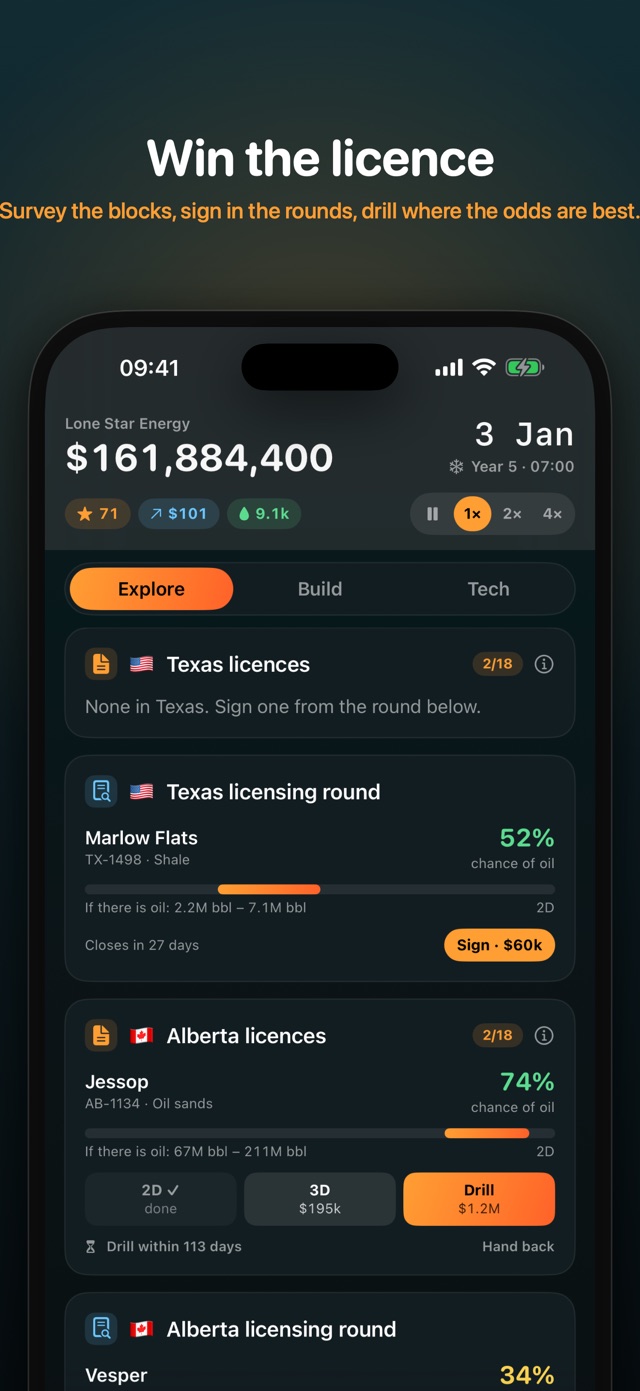
Each country you operate in has a licensing round of three blocks. Each block shows its terrain, an estimate of how much oil it might hold and the odds of finding any. Offers last 90 days, and empty slots refill most months.
Signing costs a one-off bonus that grows with the block's estimated size. Good relations with the country make licences cheaper, and in Oman every bonus costs 30% more.
Two rules to remember:
- Start an exploration well within 360 days. If you don't, the licence lapses and you lose reputation and relations.
- You can hold four licences, plus two more for each country you open beyond home. Every licence also needs a geoscientist on the staff.
You can hand a licence back at any time, but the bonus isn't refunded.
2. Survey it
A block's first estimate is wide: the real size could be a third of it, or more than twice. Seismic narrows the range and improves the call on whether there's oil at all.
| Survey | Narrows the estimate | Wrong about oil |
|---|---|---|
| None | – | – |
| 2D seismic | by about 30% | 28% of the time |
| 3D seismic | by about 60% | 12% of the time |
The Seismic imaging technology ($1.5 million) makes every survey sharper and halves its error rate. Surveys don't need a rig, so they can run while your rigs are drilling elsewhere. You can't shoot a 2D survey after a 3D one.
3. Drill the exploration well
This is the big gamble. A discovery comes on stream straight away, adds reputation and relations, and sets how many wells the field can take. A dry hole loses the licence and the money.
Costs depend on the terrain (before each country's cost factor):
| Terrain | 2D | 3D | Exploration well | Development well | New well output | Decline a year |
|---|---|---|---|---|---|---|
| Onshore | $60k | $220k | $1.6M | $1.5M | 160 bbl/d | 28% |
| Shale | $50k | $200k | $1.8M | $1.7M | 280 bbl/d | 55% |
| Oil sands | $40k | $150k | $0.9M | $2.0M | 300 bbl/d | 6% |
| Shallow water | $300k | $1.2M | $9M | $6M | 2,400 bbl/d | 20% |
| Deepwater | $0.9M | $4M | $45M | $30M | 11,000 bbl/d | 16% |
| Arctic | $0.7M | $3M | $30M | $18M | 6,000 bbl/d | 12% |
In Texas a 2D survey costs about $54,000 and an exploration well about $1.44 million, with a 34% chance of oil. Spending 4% of the well's cost on seismic first is cheap insurance. Players who skip seismic and drill more wells can still do well, but they hit more dry holes on the way.
4. Develop the discovery
A discovery gives you a field with a number of well slots, more for bigger reserves. Every development well pumps from the same pool of oil, so more wells mean the field produces faster, not that it holds more.
- New wells vary by up to a quarter either way.
- Shale wells start strong but lose more than half their output a year. Oil sands wells are slow and steady.
- Horizontal drilling adds 20% to new wells, and Extended reach gives every field a quarter more slots.
- Upgrades add 25% each, two at most: Well stimulation unlocks the first, Artificial lift the second.
Before the oil can earn anything it has to reach a buyer. Check that your trucks or pipeline can carry the extra barrels, and that you have tank space.
Going offshore and abroad
Once you're Independent you can open offices abroad, from Mexico and Egypt to the North Sea. Seventeen countries in all each have their own crude grade, royalty, tax and politics. Offshore blocks need Offshore operations, then Deepwater and Arctic operations for the frontier, at $8 million to $150 million in research. The wells cost far more, but a single deepwater well can pump more than a whole onshore field.
Exploration tips
- Shoot 2D on every promising block, then 3D on the ones still worth it.
- Don't sign more licences than your rigs can drill within 360 days.
- In Alberta, oil-sands drilling slows down in winter, from November to February.
- Not every barrel has to be found: the A neighbour is selling event offers a producing field for $2.20 a barrel in the ground.
New to the game? Start with the beginner's guide.