
You don't set the price of oil in Oil Director, so the money comes from what you control: the cost of each barrel, how you move it, who you sell it to and when. Keep your costs per barrel low, keep your promises to buyers, and don't borrow as if the boom will last.
What a barrel earns you
Every barrel you sell earns the benchmark price, adjusted for its grade:
| Crude | Share of the benchmark |
|---|---|
| Light sweet (Texas) | 100% |
| Medium sour (Oman) | 93% |
| Heavy sour (Alberta) | 80%, or 88% with Heavy oil upgrading |
From that come the country's royalty and the cost of moving the barrel. Trucking costs about $6 a barrel and a pipeline about $2.20, adjusted for each country's roads and infrastructure. Lifting costs, wages, overheads and profit tax come out of what's left.
What is left after royalty, transport and lifting costs is the netback. Know it before you drill: in Texas a barrel nets about $50 at $68 oil, while in Alberta it nets about $25.
Read the price cycle
The price moves through five moods, each pulling it toward a different level:
| Market | Price pulled toward |
|---|---|
| Glut | $34 |
| Soft | $52 |
| Balanced | $70 |
| Tight | $92 |
| Supply crisis | $125 |
Each month the market stays in its mood a little over half the time. Otherwise it shifts one step, more often back toward Balanced. Extremes don't last, but they can run for months.
The Analyst outlook forecasts the next three months for $25,000 plus a little under half a day's revenue. Each month's call is right three times out of four. Buy it before big decisions: a new well, a loan or a fixed-price deal.
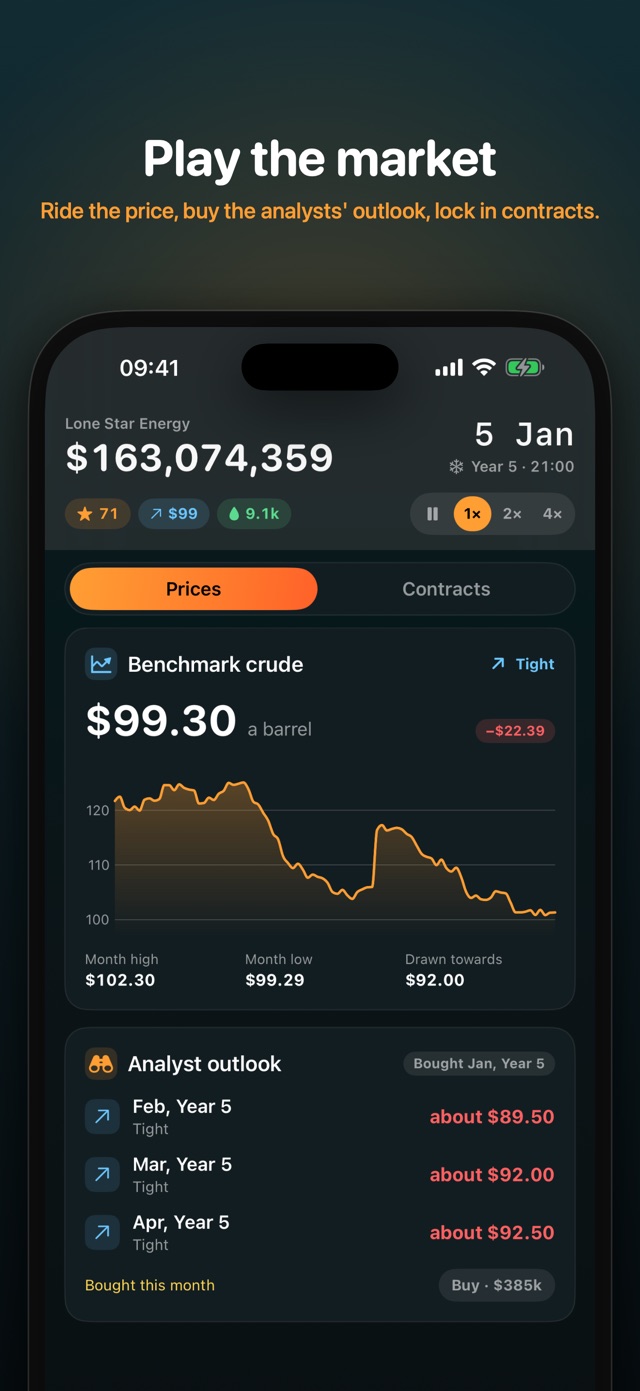
Contracts: the steady money
Buyers pay a premium over the benchmark, from $1 a barrel at Coastal Refining up to $2.80 at Halden Marine Fuels. Contracts are served first, before any barrel goes to the spot market.
- Floating contracts pay the day's price plus the premium. Each month you deliver 98% or more earns an A, which adds 25 cents to the premium, up to $2 extra.
- Fixed-price offers lock a price for six months. The price is set partway between today's price and where the market is heading, minus a small margin. Take them when the price is high and the outlook says it will fall.
Keep every contract you sign. Poor deliveries cost $3 to $8 a barrel in penalties, two bad months lose the buyer, and kept promises are the main way to build the reputation that unlocks bigger buyers, countries and loans.
Sell, store, or fill
Each country's oil follows one of three orders:
- Sell moves every barrel to market.
- Fill, then sell fills your tanks first and sells the overflow.
- Store keeps barrels back for a better price.
Storing into a spike can pay well, but tanks fill fast. Once they're full the wells are choked and the oil stays in the ground until there's room again. Build a bigger tank farm before you try it.
Move it cheaper
Trucks are cheap to start but expensive per barrel. A pipeline costs $3.5 million (less in a cheap country like Texas) plus upkeep, and saves well over $2 a barrel. At 3,000 barrels a day it pays for itself in a little over a year; at 1,000 barrels a day it takes about five. Wait until production justifies it.
Once you're Independent, an Export terminal adds $2.50 to every piped barrel, up to its capacity.
Costs to watch
- Wells decline. Onshore fields lose about 28% of their output a year, shale 55%, oil sands only 6%. Workovers restore worn wells; two upgrades add 25% each; Enhanced recovery slows decline by a quarter.
- Maintenance. Lower maintenance saves money today, but wells wear out faster.
- Staff. Every new licence, well, facility and contract needs more people. Short-staffed production and safety teams mean wells sit idle.
- Late-life fields. When a field costs more than it earns, shut it in, or plug it and hand it back.
Tax works in your favour
Profit tax is paid at month end, but every well, survey, building and licence bonus is deducted in the month you spend it, and losses carry forward. Heavy investment in a good month cuts that month's tax bill.
Borrowing
Loans start at $1 million and $3 million, rising to $800 million at Supermajor. The rate you pay depends on your reputation, so every 10 points of reputation makes borrowing cheaper. Interest-only loans can be repaid at any time. Term loans are cheaper, but their instalments are taken at month end whether or not you have the cash, and an overdraft costs 25% a year.
Borrow to drill and build when the price is Balanced or better and the outlook is steady. Don't borrow to survive a glut you could have seen coming.
Quick money tips
- When the outlook turns to Glut, lock in fixed-price offers and hold off on new wells.
- A neighbour is selling offers a mature field for $2.20 a barrel in the ground. With Texas netbacks near $50, that's usually a bargain.
- Collect milestones: First oil, Ten wells and The first million each pay a cash bonus.
New to the game? Start with the beginner's guide.