
Your first year in Vineyard Director comes down to three things: keep the vines healthy, pick each parcel at its peak, and make wine rather than selling the grapes. Do those and your estate will be making money by its second vintage. This guide walks you through the opening months on the Standard difficulty.
What you start with
Every estate opens a few weeks before harvest: 1 August in the northern regions, 1 February in the southern ones. You have $250,000, a reputation of 10, no buildings and no loan. Your vines are the region's two starter parcels, already carrying this year's crop.
Every region and every scenario is open from the start. If you want an easier or harder ride, the difficulty changes your starting cash and costs:
| Difficulty | Starting cash | Costs and building | Weather |
|---|---|---|---|
| Relaxed | $400,000 | 15% cheaper | 40% milder |
| Standard | $250,000 | Normal | Normal |
| Hard | $175,000 | 15% dearer | 30% harsher |
| Brutal | $125,000 | 30% dearer | 60% harsher |
Choose your first region
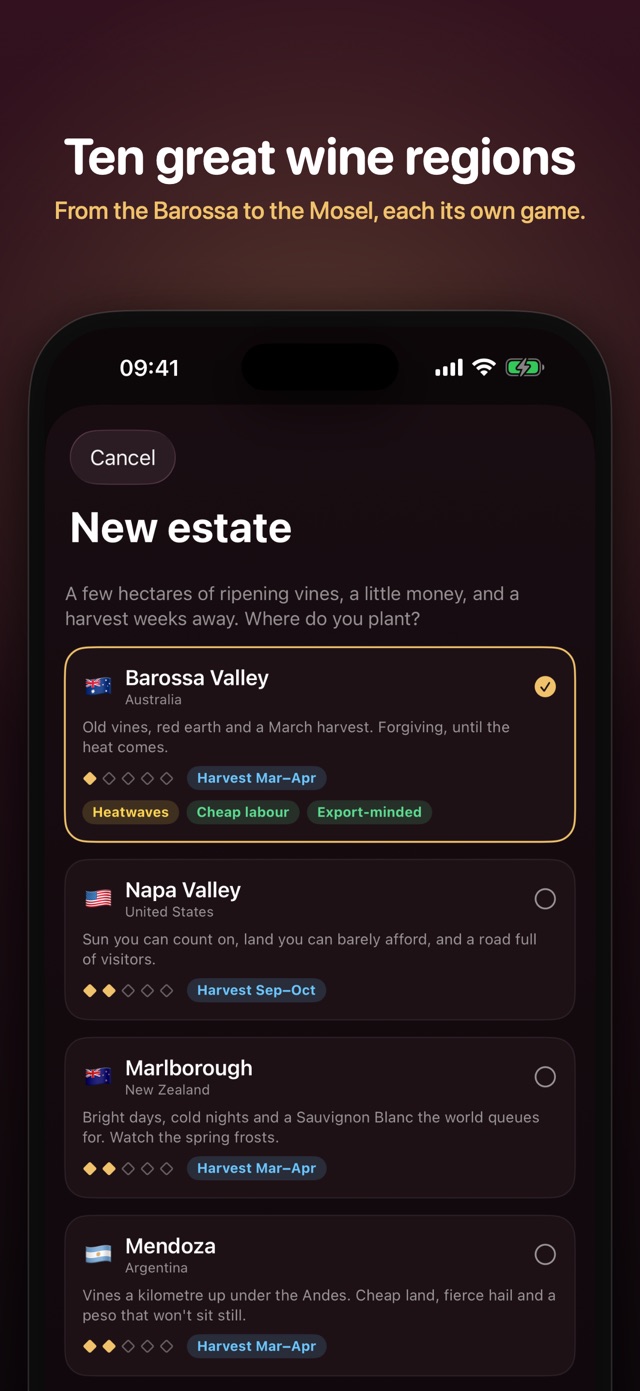
Each of the ten regions plays differently, but for a first estate pick Barossa Valley. It has some of the lowest running costs in the game, and its starter parcel, the Ebenezer Block, is three hectares of 80-year-old Shiraz that can make a wine scoring around 92 in your very first vintage.
Two other good starts:
- Marlborough gives you fast cash. Sauvignon Blanc is ready to bottle after four months, and the trade pays 8% more there.
- Mendoza has the lowest costs of all and 45-year-old Malbec on the Luján Viejo parcel.
Leave Champagne and the Mosel for later. They have the highest running costs, and Champagne must spend at least 15 months in the cellar before it can be bottled.
Before the harvest: look after the vines
Open the Vineyard tab and check each plot's standing orders. Two of them should almost never be off:
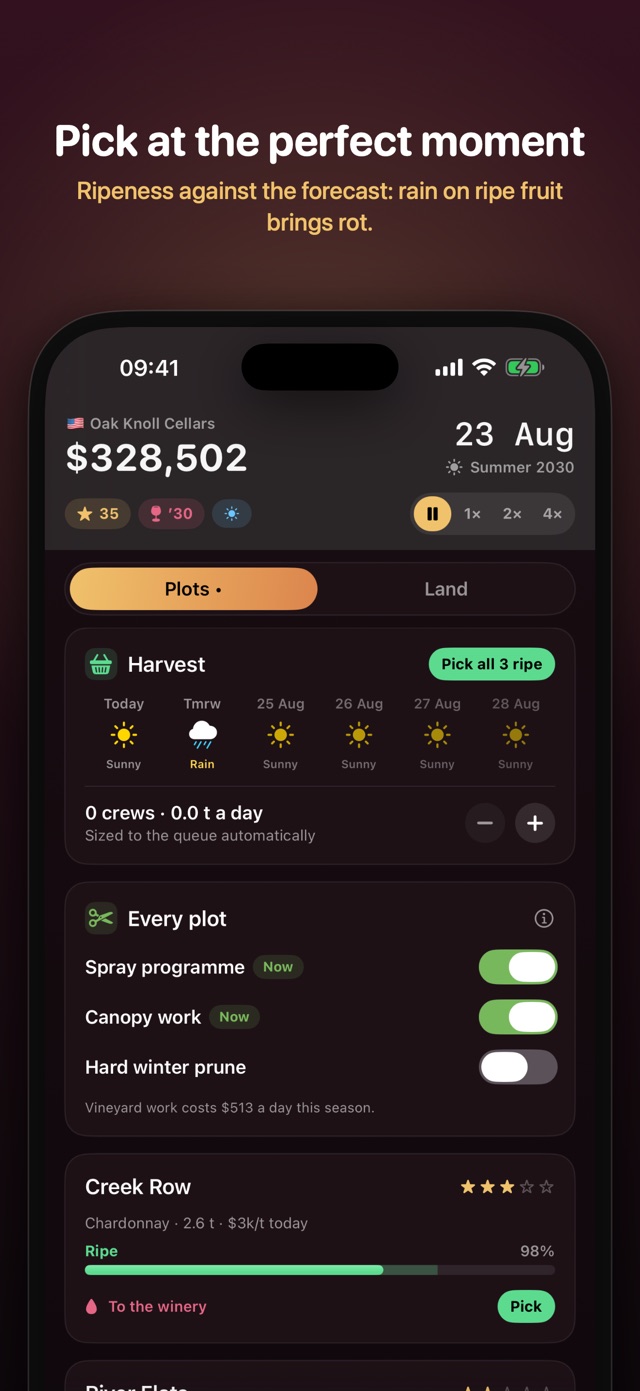
- Spray. It costs $5 per hectare a day. Unsprayed vines lose about 25 times more health on every damp day, and health cuts both the size of the crop and its quality.
- Canopy. Canopy work lifts fruit quality by about 20%. It is the cheapest quality you can buy.
Leave the hard prune and green harvest for now. They raise quality but cost you almost half the crop, which is a trade for later, once you have a name to protect.
The harvest
When fruit ripens the clock slows to a third of normal speed, so you have time to think. Ripeness 1.0 is the peak. The plot labels read Green, Véraison, Ripening, Ripe, Overripe and Shrivelling.
- Pick each parcel when it shows Ripe. If you can't be exact, err late: picking early costs two and a half times as much quality as picking late.
- Watch the Forecast. Rain on fruit that is past its peak starts rot, so pick ripe parcels before the rain arrives.
- Don't over-hire crews. The rented crusher handles 8 tonnes a day, roughly three crews' work. Fruit left waiting in the bins loses 3% a day.
Anything still hanging when the harvest closes is lost.
Make wine, not grape money
Each plot can send its fruit To the winery or sell it off the truck. Send it to the winery. In our five-year balance tests, an estate that made its own wine finished with more than twice the cash of one that sold grapes, in every region we tried.
In The winery, choose a vessel for each wine:
- Steel tank keeps fresh whites such as Sauvignon Blanc and Riesling bright and gets them to market fastest.
- Used oak is the middle ground for reds: about two thirds of new oak's lift for oak-loving grapes, without paying for new barrels.
- New French oak gives the biggest lift to grapes that love oak, but costs $1,100 a barrel.
Turn on Bottle automatically when ready so finished wines don't sit in tank for longer than they should. Ageing a wine far past its ideal time slowly lowers its quality.
Open the cellar door
Your first building should be the Tasting room ($40,000). Selling to the trade pays only 40% of a wine's list price; the cellar door pays you the full price. Visitors rise with your reputation and with the season, and summer brings 40% more than spring.
Price the cellar door so your stock lasts until the next release. A lower price sells more bottles a day but empties the shelves sooner.
Grow the estate
The cheapest way to grow is to lease a planted parcel from the Land section. There is nothing to pay up front, the fruit comes with it, and leases count towards the six hectares you need to become a Boutique Estate. The other requirements are two vintages in bottle and a reputation of 25.
New plantings are slower: vines planted this year give 60% of a crop next vintage and a full crop the year after.
Common first-year mistakes
- Switching off spraying to save money. It is the most expensive saving in the game.
- Selling the whole crop as grapes. Even selling your wine to the trade at 40% of list usually beats it.
- Building a bottling line early. At $150,000 plus $60 a day, it only pays for itself at around 10,000 cases a year.
- Blending a young wine into an old one. The blend takes the younger wine's age, so it goes back to the start of its time in the cellar.
When your first wines reach bottling, *The Cellar Report* reveals their scores. Our guide to critic scores explains what moves them, and how to make money covers the business once you have wine to sell.