A wine's critic score is fixed by the quality of its fruit and what you do to it in the cellar. Most of that quality is decided in the vineyard, long before bottling day. The right site, old vines, steady care and a harvest picked at its peak take you to around 90 points. Oak and the winery's extras take you past it.
Why scores matter
Scores are the engine of the whole game. Each extra point raises a wine's list price by about 10.5%, every bottling moves your reputation, and reputation moves the price of everything you sell. A Gold medal at the spring show needs 93 points, a Trophy 96. The top tier, Icon Estate, needs a 96-point wine.
How the score is worked out
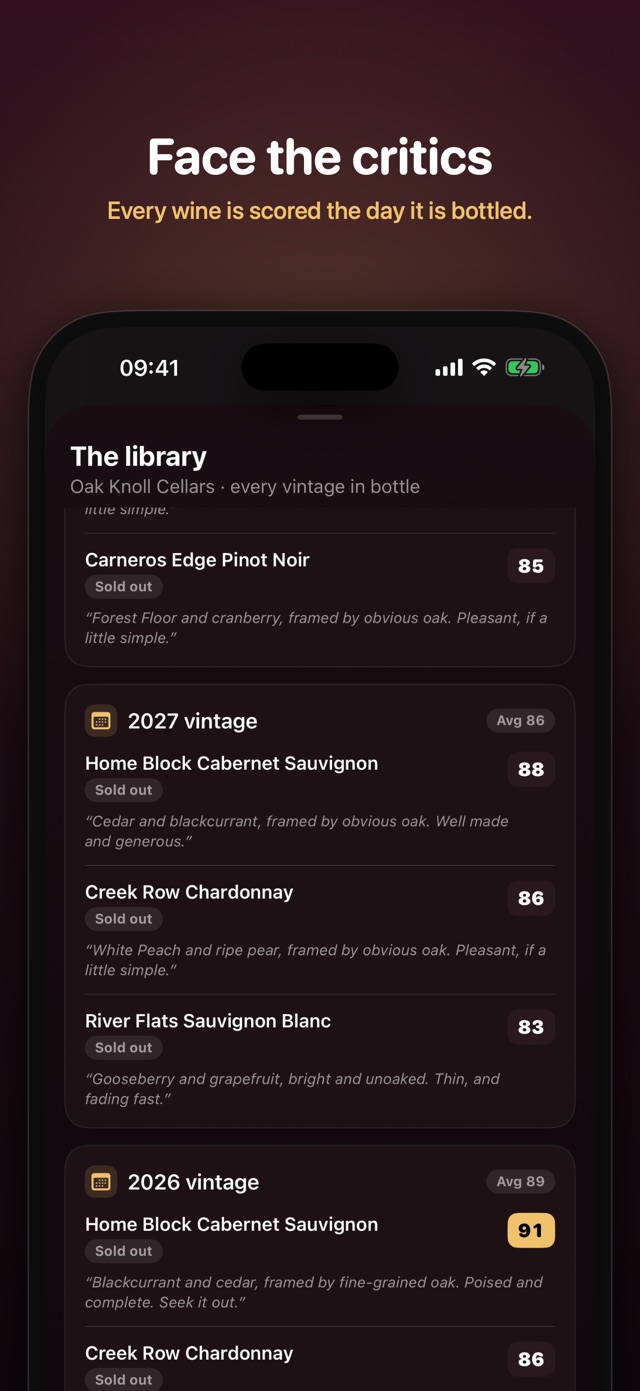
*The Cellar Report* scores each wine on bottling day from its quality, where 1.0 is an excellent wine:
| Wine quality | Score |
|---|---|
| 0.70 | about 86 |
| 0.80 | about 89 |
| 0.90 | about 93 |
| 1.00 | about 95 |
Above 94 points, extra quality counts for less than half as much, so the last few points are the hardest to earn. Scores also vary by up to about a point either way, like a real critic's palate.
Until bottling you only see the cellar's estimate. It starts wide, about five and a half points either side, and narrows to about one point as the wine ages. Early estimates can be a couple of points too generous or too harsh.
In the vineyard
Fruit quality multiplies together six things. A weakness in any one of them drags the whole wine down.
- Terroir. Each parcel has its own soil, slope and site. Terroir sets the ceiling for fruit quality, and it shows in the land price.
- The right grape for the site. Every grape has a warmth band. Planted outside it, quality falls fast. Check a parcel's warmth before you plant or replant it.
- Vine age. Young vines under three years make thinner wine. Quality builds to its full level at 20 years, and vines of 40 years or more earn a further bonus. This is why starter parcels like the Barossa's 80-year-old Ebenezer Block score so well.
- Care. Canopy work is worth up to 20% more quality. A hard prune and a green harvest add about another 14% between them, but cost almost half the crop.
- Harvest timing. Peak ripeness is 1.0. Picking early costs two and a half times as much as picking the same amount late, so if you must miss, miss late.
- Vine health. Spray to protect it. Damp days strip unsprayed vines of health, and rain on ripe fruit starts rot.
The thinning trade-off is worth doing only on your best parcels. Thinned fruit makes a wine about four points better, worth about half as much again per bottle. With a little over half the crop, revenue stays about the same, but the higher score lifts your reputation, and with it every other wine's price.
At the harvest
Fruit left in the bins loses 3% of its quality for every day it waits after the first. Don't let your pickers outrun the crusher: the rented crush takes 8 tonnes a day. Your own crush pad and fermentation tanks let you grow beyond that.
Winery upgrades add quality to everything you crush:
| Upgrade | Quality |
|---|---|
| Sorting table ($45,000) | +4% |
| Winemaker (from Boutique Estate) | +4% |
| Temperature control ($60,000) | +3% |
| Biodynamic farming | +2% |
In the cellar
Each wine ages in one of three vessels, and the lift depends on how much its grape loves oak:
- New French oak gives the biggest lift, worth up to about three points for oak-loving reds. Each barrel costs $1,100.
- Used oak gives up to about two points.
- Steel tank gives up to about one point, to grapes that don't want oak, such as Sauvignon Blanc and Riesling.
The lift builds up to the grape's ideal ageing time. Past one and a half times that, the wine starts to lose quality, so don't forget wines in barrel. Bottle automatically when ready takes care of it.
Blending two wines resets the blend to the younger wine's time in the cellar. Blend early, or not at all.
A plan for a 95-point wine
- Pick your oldest, best-sited parcel with a grape suited to its warmth.
- Keep spray and canopy on all year, and add a hard prune and green harvest.
- Pick it at Ripe, close to 1.0, and before any rain.
- Crush it the same day, through a sorting table, with a Winemaker on staff.
- Age it in new French oak for its full ideal time, and bottle it on time.
The Cult Cabernet scenario in Napa asks for exactly this: a 95-point Cabernet and a reputation of 60. If you want a gentler test, The old vines in the Barossa asks for a 93-point wine.
New to the game? Start with the beginner's guide, or see how to make money from your best wines.