
The profit in Vineyard Director comes from selling your own wine at, or close to, its full list price. Grapes and bulk wine keep the lights on, but every step closer to the customer (the trade, then distributors, then the cellar door and the restaurant) pays you more for the same bottle. Here is how each channel works and the order to unlock them.
How a bottle's price is set
Every wine has a list price, worked out when it is bottled. Four things drive it:
- The grape and the region. Cabernet from Napa starts higher than Grenache from the Barossa.
- The critic score. Each point adds about 10.5% to the price, so a 92-point wine sells for roughly half as much again as an 88. Our critic scores guide explains how to raise them.
- Your reputation. It moves every price you charge, from 80% of list at reputation 0 to 120% at 100.
- Time in bottle. Good wines gain value as they near their peak drinking age, then slowly fall back.
Organic certification adds 8% and biodynamic 14%. In Rioja and the Douro, reds aged 24, 36 and 48 months become Crianza, Reserva and Gran Reserva, worth 10%, 25% and 40% more.
Every sales channel compared
| Channel | What it pays | Unlocks | Notes |
|---|---|---|---|
| Sell grapes | Grape value, set by the market | Start | Quick cash at harvest, but the lowest return on your fruit |
| Bulk wine | 1.35× the grape value | Start | Sells the whole lot at once |
| The trade | 40% of list | Start | Any amount, instantly; 6% more in the Barossa, 8% more in Marlborough |
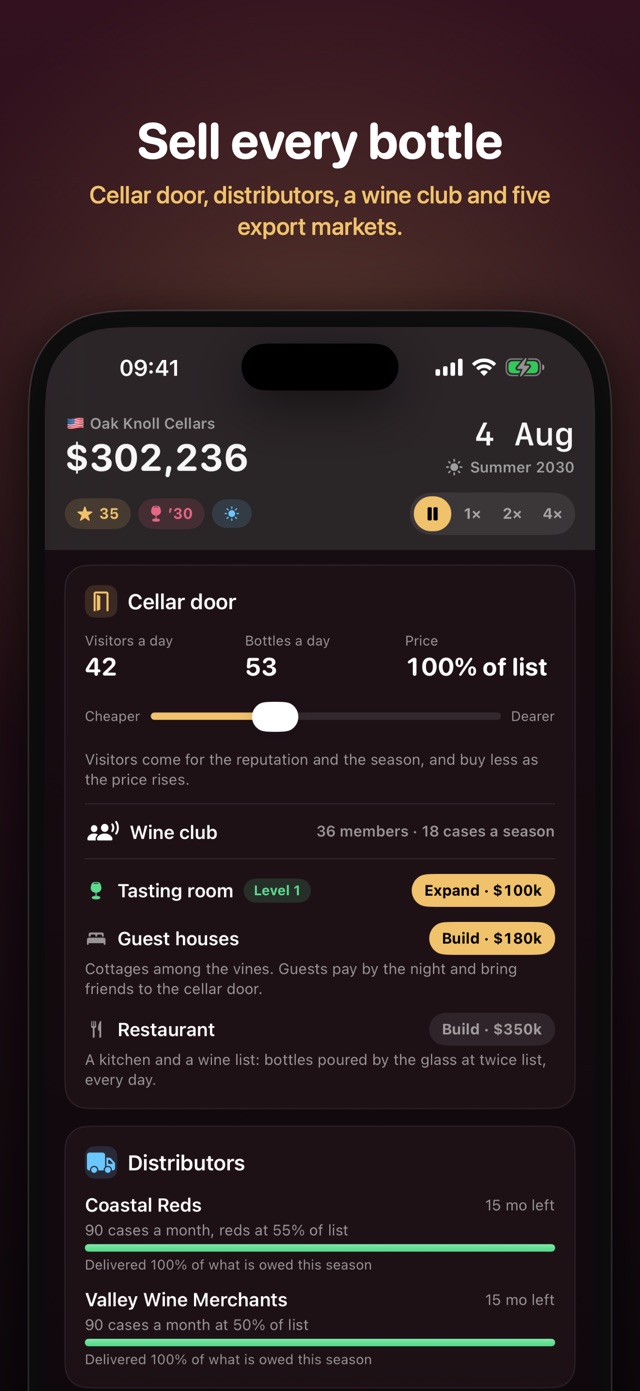
| Cellar door | 60–180% of list, your choice | Tasting room | Visitors depend on reputation, season and tourism |
| Wine club | 85% of list | Boutique Estate + tasting room | Six bottles per member every season |
| Distributors | 42–70% of list | Boutique Estate | Regular monthly cases; they grade your deliveries every season |
| Export | 40–60% of list | Established Winery | Volume grows with reputation |
| Restaurant | 2× list, plus food | Restaurant ($350,000) | 14 bottles a day at full trade, but $600 a day to run |
| En primeur | 70% of the expected price | Bordeaux only | Sell half a red lot early, after five months in barrel |
Grapes, bulk wine and the trade follow the wine market, which moves between Glut, Soft, Balanced, Firm and Boom each season. In a Glut they pay 62% of normal; in a Boom, 142%. The cellar door, distributors and importers pay list whatever the market does.
What to build first
- Tasting room ($40,000). It opens the cellar door, which pays two and a half times what the trade does. Nothing else in the game pays back faster.
- Crush pad and fermentation tanks. Renting the custom crush costs $420 a tonne (adjusted for the region's costs); your own crush pad costs $60. You also need both to become an Established Winery.
- Barrel cellar and case warehouse once your rented space fills.
- Sorting table ($45,000) for a 4% quality lift on everything you crush.
Hold off on the Bottling line ($150,000, $60 a day). It saves only about $2.20 a case, so it needs around 10,000 cases a year to cover its own upkeep. The Restaurant is powerful but costs $600 a day to run; build it when your reputation and tourism will keep it busy.
Grow with leases, not land
Leasing a planted parcel costs 7% of its land value a year, with nothing up front, and the vines arrive already bearing fruit. Buying the same land ties up the full price, and planting new vines means two years before a full crop.
Leases that pay well even if you only sold the grapes include Agrelo in Mendoza and Seppeltsfield Road in the Barossa. Some old-vine parcels lose money as grape farms but make your best-scoring wines, so lease those for the winery, not for the grape price.
If you want to own a leased parcel, you can make an offer to buy it. Offers below 80% of its value almost never succeed, and a higher reputation helps. At 85% or more the owner may counter, but after a refusal they won't talk for 90 days.
Keep distributors happy
Distributors sign you up for a set number of cases every month and grade each season's deliveries from A to D. Two C or D grades in a row and they cancel the contract and refuse to deal with you for a year. Only take contracts your cellar can supply. The offers are sized to your stock, but a bad vintage can still leave you short.
Watch the running costs
Your daily costs are made of the office ($180 a day in Napa, less in cheaper regions), vineyard crews and spraying per hectare, building upkeep and managers' salaries. Steep slopes cost 60% more to work. Before you build or hire, check the Office tab's Money section and ask whether it will earn its daily cost back.
Borrowing
The bank lends up to $200,000 as a Garage Winery, rising to $8 million as an Icon Estate. The rate starts at 7.5% and falls by half a point with each tier. Interest builds daily and there is no repayment schedule, so pay loans down when a vintage sells well.
If you stay in the red for 14 days, the bank rescues you with an emergency loan at 4 points above the normal rate, and you lose 2 reputation. An Estate manager borrows at the normal rate after three days instead, so the rescue never comes.
Quick money tips
- Don't sell grapes in a Glut. They fetch 62% of their usual price.
- Sell wine to the trade when you need cash and the market is Firm or Boom.
- Check your cellar-door stock before summer and autumn, when visitors are highest, so the shelves don't empty before the next release.
- Win medals at the spring show: a Gold (93+) adds 3 reputation, a Trophy (96+) adds 5.
- Collect milestones. They pay $5,000 to $250,000 each.
New to the game? Start with the beginner's guide.