
A new car comes down to two budgets. The design budget sets how much buyers want it, and the engineering budget sets how much it costs to build and how reliable it is. Spend enough to get above appeal 60, start the replacement before the old car fades, and plan the switch so your line isn't stopped for weeks.
Pick a segment
Your tier decides what you can build. List prices are the starting point for each car.
| Segment | List price | Unlocks at | Platform |
|---|---|---|---|
| City car | $15,500 | Workshop | Small |
| Hatchback | $21,500 | Workshop | Small |
| Saloon | $27,000 | Carmaker | Medium |
| Estate | $28,500 | Carmaker | Medium |
| Van | $30,000 | Marque | Large |
| SUV | $34,000 | Marque | Large |
| Pickup | $36,000 | Marque | Large |
| Sports car | $48,000 | International | Medium |
| Luxury | $62,000 | International | Large |
A new platform adds $3 million and four months to the project, and later $3.5 million in tooling (adjusted for local costs). Stay on a platform you already have if you can. Hybrids are available once you've researched Hybrid drive.
Set the budgets
There's no spec sheet: you set a design budget and an engineering budget. These figures are for a hatchback, and they scale with the car's list price.
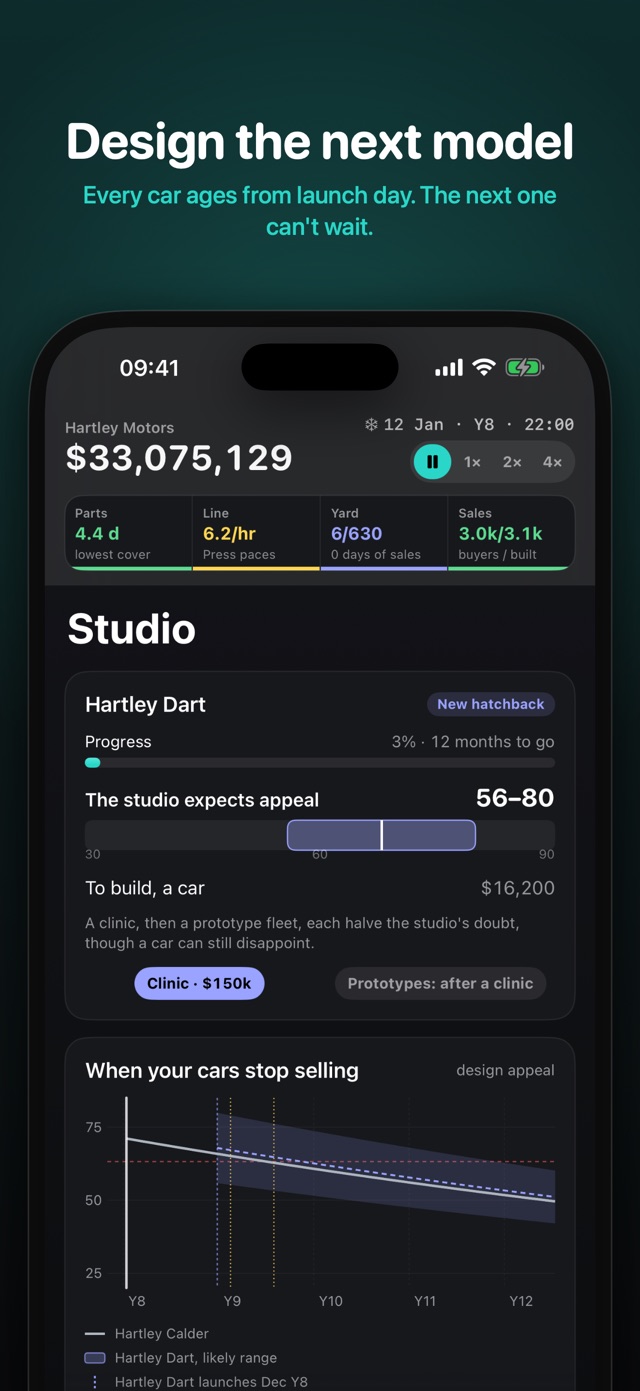
Design budget ($500,000 to $10 million) sets the car's appeal. $2 million buys about appeal 52, and each doubling adds 12 points, up to 95.
| Design budget | Expected appeal |
|---|---|
| $1 million | about 40 |
| $2 million | about 52 |
| $4 million | about 64 |
| $8 million | about 76 |
Engineering budget sets the cost of the kit and the design's built-in defects. Each doubling cuts the kit's cost by 7% and defects by about a fifth. Going from $2 million to $4 million saves more than $1,100 a car on a hatchback, which pays for itself in about seven months at 3,000 cars a year.
Don't go below about $3.2 million on design. That's appeal 60, and reviews of anything lower cost you brand points.
A project also pays for certification, which gets dearer as the years pass and as your range grows. You can run only one project at a time, you can't cancel it, and a design takes 14 months, or 12 with Computer-aided design. Studio finance can lend you 80% of the design cost, but at about 20% interest early on, it's expensive.
Clinics and prototypes
The real result carries about 10% of luck either way, and the studio only shows you an estimate. A clinic ($150,000, 30 days) and then prototypes ($600,000, 60 days) each halve the doubt in that estimate.
Neither changes the car. They only tell you what you've got. That's useful for deciding on a price or whether to plan a facelift, but if money is tight, spend it on the design budget instead.
Launch day
When the car launches, the reviews score it from 1 to 10, based on its true appeal. Your brand moves at once: a car at appeal 80 adds three points, one at 50 loses 1.5.
Launch doesn't start production, though. Switching a line to the new car stops it for 10 days if the line is already tooled for that platform. Otherwise it's 21 days plus the tooling bill. Make sure you have stock in the yard to sell during the gap.
Why your car stops selling
Every car ages. Its appeal falls by about 8% a year, and what buyers see also depends on your brand and quality.
You sell against rivals, and appeal is squared when market share is worked out, so a small lead becomes a big gap. Your rivals launch new cars on five-year cycles, each a little better than the last.
Your own cars don't compete with each other. Share is measured against rivals only, so a second model in a segment adds buyers without taking any from your first.
Facelift or replace?
A facelift costs $800,000, takes five months and makes a car 2.5 years younger. It works on cars at least a year old, and each car can have two. It's much cheaper than a new car, but it occupies the studio while it runs.
A good rhythm for a popular car: launch, facelift around year three, and start the replacement around the same time so it arrives as the second facelift wears off.
Price it right
Price matters a lot. You set a lever from 85% to 115% of list price. Each percent has a strong effect on demand, so test it in small steps.
If your line is sold out, a higher price can make more money. In Michigan at the start, 5% more sells about 211 cars a month instead of 239, but earns about $150,000 a month more. The catch is that you're selling fewer cars on the way to your next tier.
New to the game? Start with the beginner's guide, or read how to make money.