
The profit comes from two places: building each car for less, and selling every car you build. Make your own parts, make sure there are enough buyers for your line, then spread across markets where duty doesn't eat your margin. Don't pay for anything that adds capacity or demand you can't use yet.
What you earn on each car
Your income per car starts with the list price, adjusted by your price lever and the market's price level. Dealers then take 12%, and exports lose import duty and shipping on top. Cars older than 90 days also lose your clearance discount.
From what's left, you pay for the kit, wages, upkeep, dealers, energy and head office.
Build each car for less
- Build a Press. It makes stampings at 30% of the bought price, saving about $1,600 a car before local cost differences. It's the first big purchase to make, and it pays back in about five to six months.
- Build an Engine plant ($7 million, from Marque). It makes powertrains, your biggest parts bill, at 72% of the bought price.
- Spend on engineering. A bigger engineering budget on your next car lowers the kit's cost for its whole life. See how to design a hit car.
- Watch the cheap suppliers. Saving 5 or 6% on parts is tempting, but extra defects cost $5,000 for each one that reaches a customer.
Sell every car
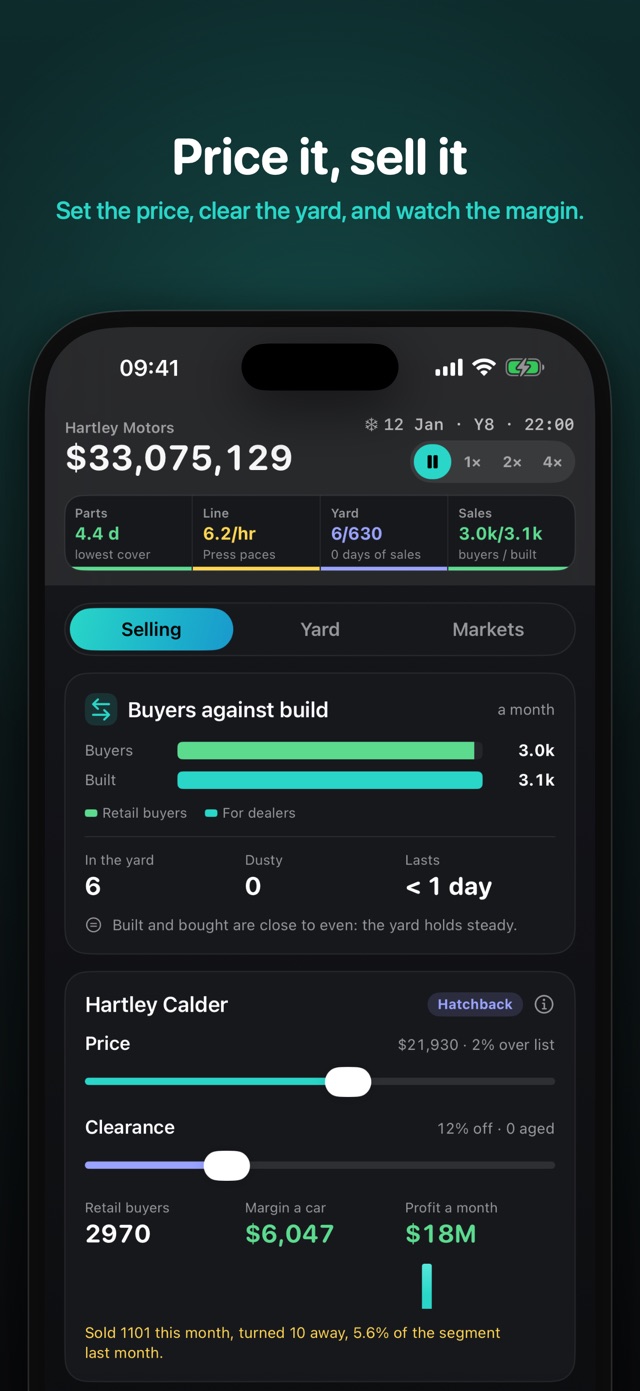
The Buyers against build card tells you which problem you have.
More buyers than cars? Build more. Find the bottleneck, then add a shift. Extra dealers and marketing earn nothing until you have cars for them to sell. You can also raise your price: in Michigan at the start, 5% more sells about 211 cars a month instead of 239, but earns about $150,000 a month more.
More cars than buyers? Your yard will fill, and a full yard stops the line. Your options:
- Add dealers. Each costs about $500,000 (adjusted for local costs) plus $300 a day, and 200 reach everyone in a market. With spare cars, one pays back in about three months in Michigan, five in Pune and eight in Coventry.
- Lower the price, using the lever from 85% to 115%.
- Market at home. Up to 40% more buyers, and half of that for $120,000 a month. It doesn't work abroad.
- Launch a second car. Your own cars don't compete with each other, so a second model adds buyers.
- Open a new market.
Open new markets
Markets open with your tier and brand, and the entry fee includes dealers, which makes them good value. Germany's $1.5 million comes with 10 dealers that would otherwise cost $5 million.
| Market | Tier | Brand | Entry fee | Dealers included |
|---|---|---|---|---|
| Canada | Carmaker | 30 | $1 million | 8 |
| France | Carmaker | 35 | $1.2 million | 10 |
| Germany | Carmaker | 40 | $1.5 million | 10 |
| Japan | Carmaker | 45 | $2 million | 12 |
| Mexico | Marque | 40 | $2 million | 12 |
| Australia | Marque | 45 | $2 million | 10 |
| Brazil | Marque | 45 | $3 million | 15 |
| South Korea | Marque | 50 | $2.5 million | 10 |
| Italy | International | 55 | $3 million | 12 |
| Nordics | International | 55 | $2.5 million | 8 |
| China | International | 55 | $8 million | 25 |
The other two home markets open free at Carmaker, without dealers. Each model also has to pass tests before it can go on sale in a market, at around $250,000 and 90 days.
Mind the duty. There's no duty inside the US, Canada and Mexico group, or between Germany, France, Italy and the Nordics. The UK and Japan deals halve it. Better relations with a country also cut it. Build a plant in a market with high duty, from International (or at home from Marque), though plants cost $26 to $58 million and take 300 to 450 days.
Fleet contracts
From Carmaker, fleet buyers offer regular orders, and you can hold more contracts as your tier grows. Deliveries are graded from A to D each month, and two poor months lose the buyer. Only sign what your line can spare.
Grow the right way
- Tax: the yearly bill is 25% of profit, rising to 50% above $200 million. Losses carry forward, and new equipment and studio spending count as expenses, so spending before December lowers that year's bill.
- Scale costs: every plant, market and model adds to a company's size, and past a point overheads rise quickly. Each extra plant also adds regional overhead. Don't open markets you won't really serve.
- Goals: 25 goals pay from $20,000 to $5 million.
Borrowing
You can hold one bank loan at a time, from $1 million and $3 million at the start to $500 million at Global Group. The rate depends on your brand: at a brand score of 30, $3 million costs about 13.75% interest-only. Shorter terms are cheaper, at two points off for 24 months and one point off for 48.
Borrow for things that pay back, like a Press or a second shift with the buyers to match. An overdraft costs 12% a year and hurts your brand, and if you end two months deep in the red, the bank steps in.
Buy a rival
At International you can buy a rival outright. The price is $800 for each car it sells a year at home. You get its cars, a two-line works and 40 dealers. The Rivals list shows each one's price, and it can be a good deal compared with building a plant from scratch.
New to the game? Start with the beginner's guide.