
Your line builds cars only as fast as its slowest station, so the job is always the same: find the bottleneck, fix it, and find the next one. Speed is the expensive way to build more. Adding shifts and upgrading stations costs money up front, but it doesn't wreck your quality.
The five stations
| Station | Cars an hour at level 1 | First upgrade | Build time | Crew per shift |
|---|---|---|---|---|
| Press | 1.8 | $1.6 million (to buy) | 45 days | 8 |
| Body | 1.15 | $380,000 | 12 days | 10 |
| Paint | 1.0 | $450,000 | 16 days | 8 |
| Assembly | 1.1 | $320,000 | 12 days | 14 |
| Test | 1.45 | $220,000 | 10 days | 6 |
Each level adds 45% of the station's base rate. Each one also doubles the upgrade cost, adds five build days and two crew per shift, and raises upkeep by 60%. Stations top out at level 5, and your tier sets the limit: Workshop can reach level 2, Carmaker 3, Marque 4, and International 5. The old level keeps working during an upgrade, so the line doesn't stop.
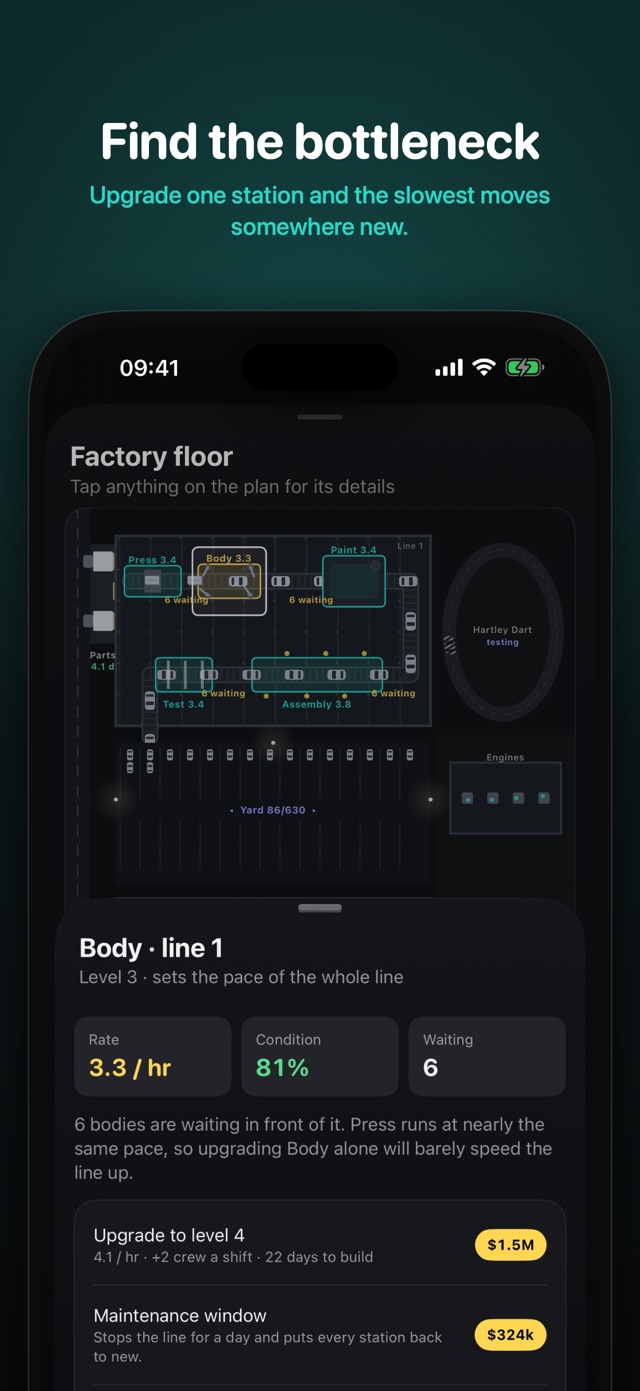
Find the bottleneck
The Plant tab shows which station is setting the pace. At the start it's Paint at 1.0 car an hour. Upgrade Paint and Assembly takes over at 1.1, then Body at 1.15.
Small buffers of up to six bodies sit between stations, so a brief stop won't halt the whole line, but only the slowest station decides how many cars you build.
Shifts or speed?
You have two quick ways to build more, and they cost very different things.
Shifts. A second shift doubles your hours for a 15% pay premium, and a third adds 30%. The cost is the extra crew: in Coventry a second shift costs about $97,000 in hiring fees and about $10,400 a day. It needs about 142 more buyers a month to break even, so add dealers with it. Night shifts wear machines 1.5 times as fast.
Line speed. You can run the line from 80% to 120%. It's instant, but above 100% it's expensive three ways:
- Defects and wear rise with the square of the speed.
- Crew pay climbs by 1.6% for every 1% over 100.
- Energy use rises too.
Use speed for short bursts, not as a way of life. Dropping below 100% is a good way to improve quality when you have more cars than buyers.
Wear and service
On one shift, stations wear down to about 60% condition in roughly three months. A worn station runs up to 25% slower, produces more defects, and breaks down far more often. A breakdown takes four to 16 hours to repair.
A service stops the line for 24 hours, costs $18,000 per station level (adjusted for local costs), and resets every station. Book one before you need it. The Maintenance budget lever in the Office changes how fast things wear.
Quality
A car's defects come from its design, the line's speed, wear, training, short crews and your suppliers. Defects also fall as you build more of a model, down to 65% of where they started after about 3,000 cars.
The Test station catches defects and sends those cars back to Assembly. It catches 55% at level 1, plus eight points for each further level, up to 95%. What it misses reaches customers, and each one costs $5,000 in warranty claims.
Your quality score falls as more defects escape. Below 65, recalls become a real risk, at 1.2% a month for every point under. A recall costs $450 a car, two brand points and a three-day stop. You can stonewall instead, but that's a coin flip on losing 12 brand points.
Keep the parts coming
Every car takes one of each of five part families, and if any of them runs out, the line stops.
| Part family | Share of the kit's cost |
|---|---|
| Powertrain | 30% |
| Interior | 20% |
| Electronics | 18% |
| Chassis and wheels | 18% |
| Stampings | 14% |
Each family has three suppliers:
- Standard: full price.
- Cheap: 5 to 6% less, but 10 to 12% of deliveries come late and defects rise by 25 to 30%.
- Premium: 6% more, with 20% fewer defects. It needs Carmaker.
Changing supplier costs $60,000. You can make your own parts too: a Press makes stampings at 30% of the bought price, and an Engine plant ($7 million, from Marque) makes powertrains at 72%.
Watch the yard
Finished cars wait in the yard. Your first yard holds 150, and each extension adds 120 for $250,000, rising 60% each time. A full yard stops the line, and every car costs $6 a day to keep. Cars older than 90 days sell at your clearance discount, which is 12% unless you change it.
If the yard keeps filling, you have a sales problem, not a production one. See how to make money.
Growing past one line
A second line costs $9 million, takes 90 days and needs Marque, and a plant can hold two. Two models on the same platform can also share one line, in any mix from 10 to 90%. To build more than that, you'll need another plant.
New to the game? Start with the beginner's guide.