
Hotel Director turns the business side of hotel management into a game. You don't carry bags or check guests in: your staff do that. You make the decisions a general manager and an owner make, the rate, the team, the repairs, the borrowing, and the game's numbers follow from them the way a hotel's accounts would. It's a game, not a training course, but if you've worked in a hotel or studied hospitality, most of it will feel familiar.
The real job, and how the game plays it
| In a real hotel | In Hotel Director |
|---|---|
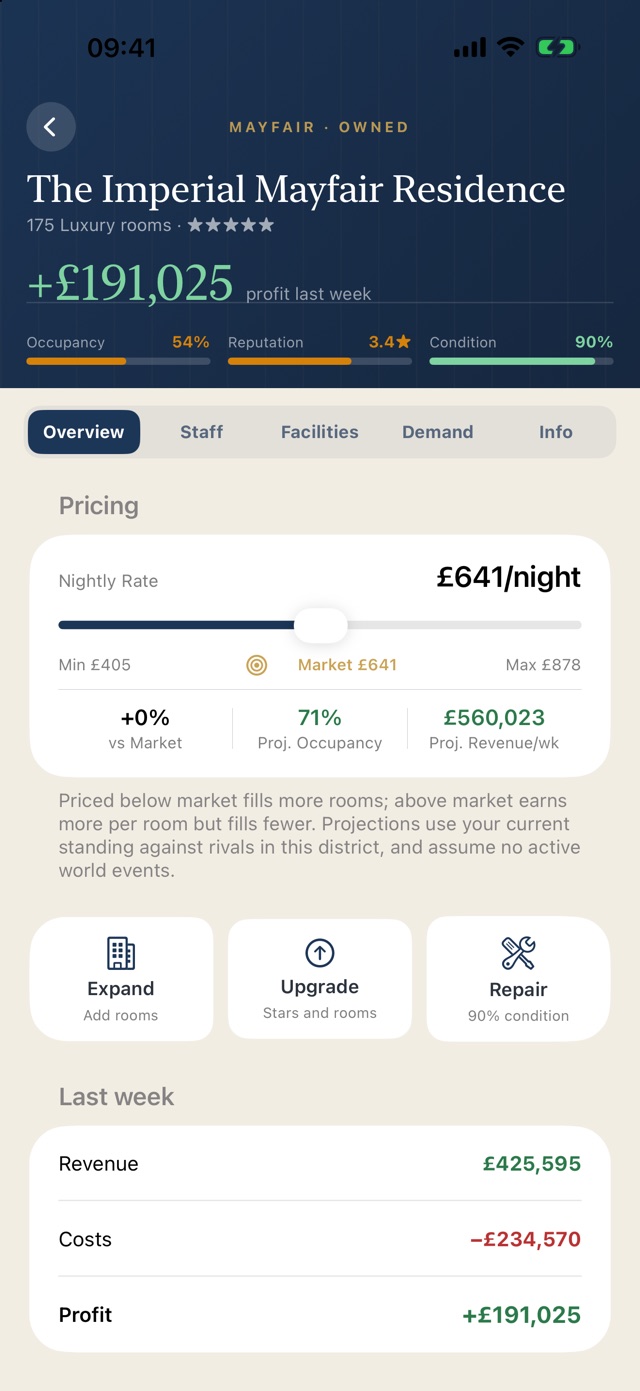
| Revenue management | Every hotel has a market rate for its room tier and district. Set your rate on a slider, and see the projected occupancy and revenue before you commit. |
| Staffing levels | Your star rating sets the team you need. A two-star hotel needs a receptionist for every 30 rooms and a housekeeper for every 20, and every missing role costs guest satisfaction. |
| Maintenance | Without a maintenance tech the building's condition falls every week. A broken boiler costs you guests until you pay to fix it, and insurance repairs it the same week for an excess. |
| Guest satisfaction | Cleanliness, check-in, facilities and value add up to satisfaction, which drives reputation, which drives demand. |
| Sales and marketing | Campaigns, booking channels, a sales manager and a marketing manager. |
| Compliance | Renew the fire certificate every year, or risk fines. |
| Property | Lease with no deposit, or buy with a 25% deposit and a mortgage. Leases come with rent reviews; mortgages with repossession if you miss payments. |
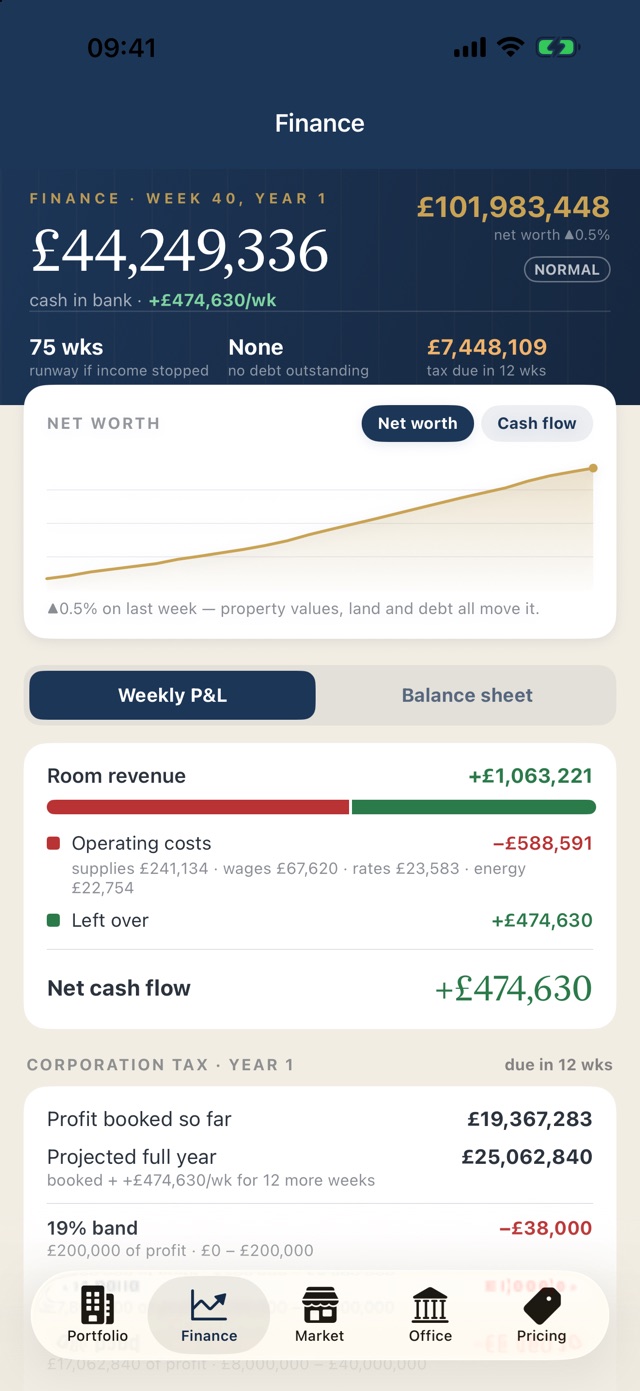
| Finance | A weekly profit and loss account: room revenue and restaurant takings, then wages, energy, business rates, maintenance, rent or mortgage, insurance and corporation tax. |
The rate decision
The central question in hotel revenue management is whether to fill rooms or charge more for each, and the game asks it every week. Cutting your price below the market lifts occupancy, but only so far, and every room you sell earns less. In our test runs on a 40-room London hotel, pricing at 80% of the market filled 86% of the rooms and made about £5,700 a week; pricing at 110 to 120% of the market sold fewer rooms but made about £8,100.
That's the lesson revenue managers learn too: compare revenue, not occupancy. The room rates guide shows how demand is worked out.
Profit isn't cash
A hotel group can show a profit and still go bust. Rent, wages, loan repayments and the year-end tax bill can all land in the same week, and three weeks in a row with negative cash ends the game. Leased hotels earn money but don't add to your net worth, so growing with leases alone won't open the better parts of London.
Corporation tax is charged in week 52 on the year's operating profit, with a warning in week 49. Interest rates move with the economy, and you can refinance when they fall. Read how to grow without running out of cash.
A city with its own calendar
Demand changes through the year, as it does for a real hotel. London's summer is busy and January is quiet. The London Marathon and Fashion Week bring extra guests, and so does the Christmas shopping season. Transport strikes, energy crises, recessions and travel booms move demand and interest rates, and guests leave reviews that move your reputation.
When the group gets big
Running six hotels by hand is a lot of work, so, as in a real group, you can delegate at a price. A local manager runs one hotel and sets its prices. HR agencies, revenue managers and supplier contracts take over the routine. Reach the London Brand tier with five or more hotels and you can set up a Head Office.
Play it
Hotel Director is free on iPhone, and London plays in full with no time limit. More cities and features are optional purchases; see what's free. There are no ads, no timers and no energy bars, it plays offline, and it needs iOS 26 or later.
Frequently asked
Is Hotel Director realistic? The decisions and the accounts work the way a hotel's do: rates against the market, staffing for your star rating, maintenance, leases, mortgages and tax. The hotels and rival groups are fictional, and the numbers are tuned to make a good game.
Do I run the front desk? No. Your staff look after the guests. You decide how many staff to hire, what to pay them and what the hotel charges.
Is it real time? No, it's turn-based. Each turn is one week, and nothing happens until you end it, so you can take as long as you like over a decision.
Is there a goal? It's open-ended. You track your progress by net worth, brand tier and your place on the leaderboard against four rival groups.